
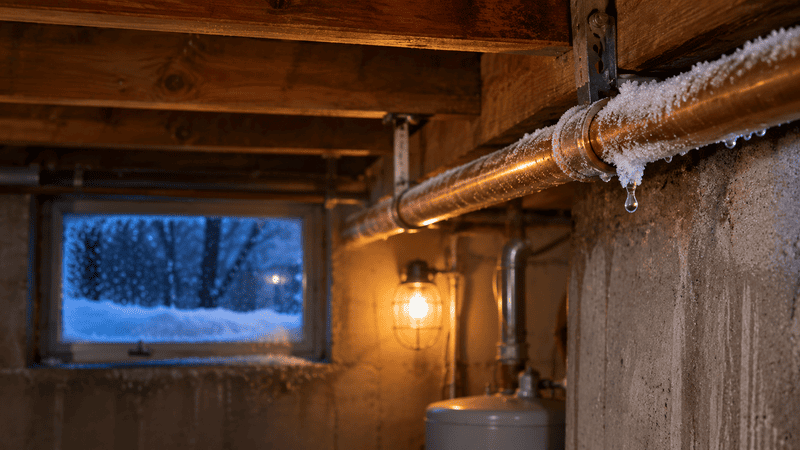
It’s the Sunday after Thanksgiving. You’ve been at your sister’s in Cincinnati since Wednesday. You pull into the driveway a little after dark, carry the leftovers in, and hear it before you see it.
Running water. Somewhere below you.
A supply line in the basement froze Friday night, split, and has been running ever since. The drywall is wet to the knee. The carpet squishes. Boxes of Christmas decorations are sitting in an inch of water.
You find the shutoff, and the next question shows up:
Is this covered?
Usually, yes. A burst pipe is one of the most common claims we see every winter at Lew Griffin Insurance Group. But nearly every homeowners policy has one clause that decides whether that claim gets paid, and almost nobody reads it until the water is already on the floor.
A Burst Pipe Is One of the Most Expensive Claims a Homeowner Can File
This isn’t a small-dollar problem.
State Farm reported paying more than $628 million on over 20,000 frozen-pipe and winter water claims between January 2024 and June 2025, an average of more than $30,000 per claim.
Across the industry, the Insurance Information Institute says water damage and freezing made up about 22.6% of all homeowners claims in 2023, second only to wind and hail.
Why so expensive? A split half-inch supply line can push out hundreds of gallons an hour. The pipe is the cheap part. The drywall, flooring, cabinets, insulation, furniture, drying equipment and the hotel you stay in while the house dries out are not.
Does Homeowners Insurance Cover Frozen Pipes?
In most cases, yes. Standard homeowners policies cover water damage that is sudden and accidental. A pipe that freezes, splits and floods your basement fits that description.
Here’s how a typical policy breaks it down:
- Usually covered: water damage to the house itself (drywall, floors, ceilings, cabinets) and to your belongings, minus your deductible.
- Usually covered: the cost to open a wall or floor to reach the broken pipe, and to put it back.
- Usually covered: additional living expenses if a covered loss leaves the house unlivable during repairs.
- Usually not covered: the broken pipe itself. Many policies pay to tear out and replace the wall, not to replace the plumbing that failed.
- Usually not covered: slow leaks that went on for weeks or months. Insurers treat that as maintenance, not an accident.
- Often limited: mold. Many policies cap mold coverage well below what a serious remediation costs, which is one more reason to move fast.
That’s the general picture for frozen pipes and homeowners insurance. The exact answer is in your policy, and the most important part is the clause below.
The “Heat Clause” That Can Turn a Covered Claim Into a Denied One
Almost every homeowners policy has some version of a freezing exclusion. The standard wording says the policy won’t pay for freezing damage to your plumbing, heating system or appliances while the home is vacant, unoccupied or under construction, unless you used reasonable care to either:
- maintain heat in the building, or
- shut off the water supply and drain the system and appliances.
Read that twice. It isn’t really about whether you were home. It’s about whether you kept the heat on or drained the water.
If you spend a month in Florida, leave the thermostat at a sensible setting and the furnace keeps running, a burst pipe is generally covered. If the furnace quits in week two and nobody checks the house until you get back, the insurance company is going to ask whether that was “reasonable care.”
Courts have sided with insurers on that question. In one New York case, the court found a homeowner had not used reasonable care because the house sat unoccupied for three winter months and no one had been arranged to check on it.
There’s no number attached to “reasonable care.” That’s the catch. It gets decided after the loss, by an adjuster looking at your thermostat setting, your furnace history and who was keeping an eye on the place.
Where Frozen Pipes and Homeowners Insurance Collide in Central Ohio
The same situations come up every winter:
- Snowbirds. Two or three months south with no one checking the house is exactly what this clause was written for. For a long trip, shutting off the main and draining the lines is the other option the policy allows. Have a plumber do it if you’re unsure, and know that shutting off the water also disables any fire sprinkler system.
- Holiday travel. A week away during a cold snap, with the thermostat turned way down to save on the gas bill, is one of the most common ways a pipe on an exterior wall freezes.
- A parent’s house that’s sitting empty. Mom moved to assisted living, or the house is waiting to be sold after a death in the family. Policies treat an empty house very differently, and some coverages can be reduced or excluded once a home has been vacant for 60 consecutive days. Call us the week the house goes empty, not after the first freeze.
- Renovations. “Under construction” is in the same exclusion. If the kitchen is gutted and a contractor has the back door propped open in January, read our post on renovations and insurance before the work starts.
- Rentals and second homes. Landlord and seasonal policies often have tighter freeze conditions than a standard homeowners policy, sometimes whether or not the property is vacant.
The houses matter, too. In older farmhouses around our Baltimore office, plumbing often runs through crawl spaces and outside walls that were never insulated for it. In neighborhoods around Gahanna, the usual suspects are the bathroom over the garage and the kitchen sink on an exterior wall.
How Cold Does It Have to Get?
Pipes can freeze any time it’s below 32°F, but the real risk starts when outdoor temperatures drop to about 20°F or lower, especially for pipes in unheated spaces or against outside walls. Insulated pipes can freeze in a matter of hours at those temperatures.
Central Ohio gets nights like that most winters. The first hard cold snap usually catches people who haven’t done the basics yet.
How to Prevent Frozen Pipes (and Protect Your Homeowners Insurance Claim)
Most of these take minutes. Several also double as proof that you used reasonable care.
- Find your main water shutoff now. Make sure it turns, and show everyone in the house where it is. The difference between a $5,000 claim and a $40,000 claim is often how long the water runs.
- Disconnect garden hoses and shut off and drain outdoor spigots that aren’t frost-free.
- Insulate exposed pipes in crawl spaces, garages, attics and unfinished basements. Foam pipe sleeves cost a few dollars at the hardware store.
- Open cabinet doors under sinks on outside walls during a cold snap so warm air can reach the pipes.
- Let a faucet drip on the coldest nights if it’s fed by pipes in an exterior wall. Moving water is harder to freeze.
- Don’t turn the heat way down when you leave. The American Red Cross recommends no lower than 55°F. Some policies say more about this than others, so check yours, and note what you set it to.
- Have someone check the house every day or two if you’re gone during cold weather. Make sure they know where the shutoff is.
- Consider a smart leak detector or Wi-Fi thermostat that alerts your phone when the temperature drops or water appears. Some carriers offer a discount for them. Ask us.
- Have the furnace serviced before winter and keep the receipt.
If a Pipe Bursts: What to Do First
- Shut off the main water valve. Then cut power to any wet area if you can do it safely.
- Take photos and video before you clean anything: the split pipe, the standing water and the damaged belongings.
- Stop the damage from getting worse. Your policy expects reasonable steps to protect the property: mop up, move belongings to a dry area, run fans, call a water mitigation company. Keep every receipt.
- Keep the broken section of pipe if a plumber cuts it out. The adjuster may want to see it.
- Call us before you sign anything with a restoration company. We’ll help you open the claim the right way and explain what your coverage and deductible mean for this loss.
A note on deductibles: if yours is $2,500 and the damage is a stained ceiling tile and a wet rug, filing may not make sense. We walk through that trade-off in Should I Choose a Higher Deductible to Lower My Insurance Premium?
Two Coverages Worth Asking About Before Winter
Water backup coverage. A burst pipe and a backed-up drain or failed sump pump are not the same claim. Standard homeowners policies typically exclude water that backs up through a drain or overflows a sump pit. In a finished basement, that’s a painful gap, and it’s usually an inexpensive endorsement to add.
Service line coverage. The water line running from the street to your house is generally the homeowner’s responsibility. A standard policy usually won’t pay to dig it up and replace it if it freezes or breaks underground. Some carriers offer service line coverage as an add-on.
And remember that flood insurance is a separate policy. Water coming in from outside after heavy rain or snowmelt isn’t a frozen pipe claim.
Frequently Asked Questions
Does homeowners insurance cover frozen pipes? In most cases, yes. Sudden water damage from a pipe that freezes and bursts is generally covered, minus your deductible. If the home was vacant or unoccupied, most policies require that you used reasonable care to keep the heat on or to shut off and drain the water.
Will insurance pay to replace the pipe itself? Usually not. Most policies pay for the water damage and for opening and repairing the wall or floor to reach the pipe, but not for the failed plumbing.
What temperature should I set my thermostat to when I’m away? The American Red Cross recommends no lower than 55°F. Check your policy for any specific requirement, and have someone check the house during long absences.
Is a burst pipe covered if I was on vacation? Generally, yes, if you kept the heat on or shut off and drained the water. The claim gets harder when the heat failed or was turned off and no one was checking on the house.
Does renters insurance cover frozen pipes? Renters insurance covers your belongings damaged by a burst pipe. Damage to the building itself is usually the landlord’s responsibility and falls under their policy.
Will a frozen pipes claim raise my homeowners insurance premium? It can. Water claims are watched closely by insurers, and how one affects your rate depends on your carrier and your claims history. If the damage is close to your deductible, call us first and talk it through.
A Frozen Pipe Doesn’t Care What Your Policy Says
But your adjuster will.
The best time to find out how your policy handles freezing and vacancy is now, before the first 15-degree night and before you pack the car for Thanksgiving.
If you’re not sure what your policy says, call us or stop by. An annual review takes a few minutes. We’ll look at your freezing and vacancy language, your deductible and whether water backup coverage makes sense for your basement.
Because when the water’s running at 2 a.m., your insurance is only as good as your agent.
Contact Lew Griffin Insurance Group — Gahanna: (614) 475-0036 · Baltimore: (740) 862-3800
Lew Griffin Insurance Group Gahanna & Baltimore, Ohio Home • Auto • Life • Business