
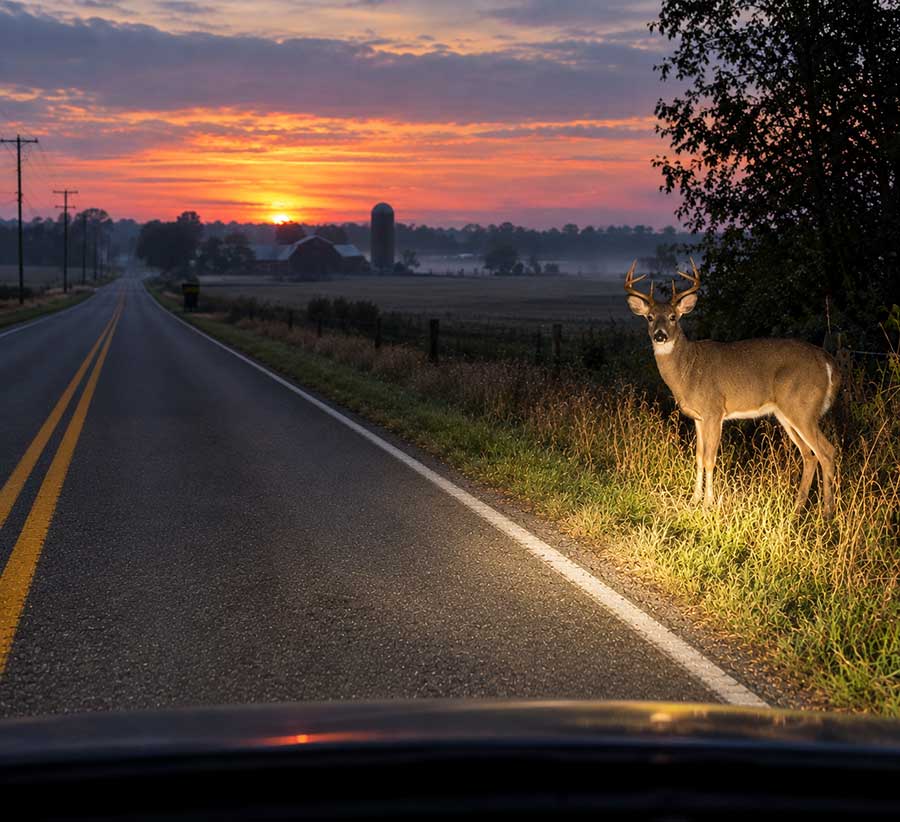
It’s 6:40 on a November morning. You’re heading out of town on State Route 256, coffee in the cupholder, headlights still on.
Something brown moves at the edge of the beam.
By the time your foot finds the brake, it’s over. The deer is gone. Your headlight isn’t. Neither is half your front bumper.
You’re shaken, but you’re okay. And about ten minutes later, the next question shows up:
Is this covered?
We hear that question every fall at Lew Griffin Insurance Group. The honest answer is that it depends on one coverage you either kept or dropped—and on one split-second decision you made before impact.
Deer Season Is Crash Season in Ohio
This isn’t a once-in-a-lifetime event. In Ohio, it’s a seasonal pattern.
According to the Ohio State Highway Patrol, roughly 47% of deer-involved crashes happen in October, November and December, and about 22% happen in November alone. Dawn and dusk are the danger zones: about a quarter of these crashes occur between 5:00 and 8:00 a.m., and nearly a third between 6:00 and 10:00 p.m.—exactly when most of us are commuting.
The good news: about 95% of Ohio deer crashes involve property damage only.
The less good news: that property damage isn’t cheap anymore. The Insurance Institute for Highway Safety put the average animal-collision claim at nearly $6,000 in 2023, and it’s climbing.
Why so expensive? Look at the front of a newer car. The bumper isn’t just a bumper. It may hold parking sensors, radar for adaptive cruise control, cameras and LED headlight assemblies that can cost more than some people’s first car. A “minor” deer hit can mean parts, labor and sensor recalibration.
Hitting a Deer Is Usually a Comprehensive Claim—Not Collision
This is the part that surprises people.
Most auto policies split physical damage to your own car into two coverages:
- Collision pays when your car hits another vehicle or an object—a guardrail, a pole, a tree.
- Comprehensive (sometimes called “other than collision”) pays for things like theft, hail, falling branches, fire—and hitting an animal.
So even though it feels like a collision, a deer strike is typically handled under comprehensive. That matters for two reasons.
First, it’s comprehensive’s deductible that applies, which may be different from your collision deductible.
Second, with most insurance companies, an animal strike is generally not treated as an at-fault accident. How a claim affects your future premium still varies by company, so it’s worth asking your agent how your carrier handles it before you need to know.
Swerving Can Change Everything
Here’s the split-second decision we mentioned.
Your instinct says swerve. The Ohio State Highway Patrol says the opposite: brake firmly, stay in your lane and don’t swerve.
That’s a safety rule first. Swerving can send you into oncoming traffic, off the road or into a tree. Those are the crashes that hurt people.
But it’s an insurance issue, too.
If you hit the deer, that’s usually a comprehensive claim. If you miss the deer and hit a guardrail, a mailbox or a parked car, that’s usually a collision claim—with its own deductible, and with many carriers, a better chance of being treated as at-fault.
Same deer. Same morning. Very different claim.
If you ride a motorcycle, this matters even more. Motorcycles are involved in only a small share of Ohio deer crashes, but they account for the large majority of the fatal ones.
The “Liability Only” Gap
This is the conversation we have far too often in November.
A few years ago, you paid off your car. To save money, you dropped comprehensive and collision and kept liability only. That’s a reasonable decision for some vehicles.
But liability coverage pays for damage you cause to other people. It doesn’t pay to fix your car.
Without comprehensive, a deer strike comes out of your pocket.
It’s also why we remind people that “full coverage” isn’t a real coverage. It’s a phrase. What matters is what’s actually listed on your declarations page.
If you’re driving an older car without comprehensive, run some quick math:
- What would it cost to repair or replace this car tomorrow?
- Could you cover that comfortably out of pocket?
- What would adding comprehensive back actually cost you per year?
Comprehensive is often less expensive than people expect, especially compared to collision. For some drivers, adding it back is an easy call. For others, self-insuring still makes sense. Either way, it should be a decision—not something you discover from the shoulder of the road.
Check These Three Things Before November
Pull up your auto insurance policy and look for:
- Comprehensive coverage. Is it there on every vehicle that needs it?
- Your comprehensive deductible. If it’s $1,000 or more, make sure you’re comfortable paying that tomorrow.
- Rental reimbursement and towing. Body shops tend to be busiest in late fall, and parts can take time. A car that’s out of commission for weeks gets expensive fast without rental coverage.
What to Do Right After You Hit a Deer
If it happens, here’s the order that matters:
- Get to a safe spot. Pull fully off the road if you can and turn on your hazard lights.
- Check on everyone in the car. Call 911 if anyone is hurt.
- Report it. Call 911 or dial #677 to reach the nearest Ohio State Highway Patrol post. A crash report can help support your claim.
- Stay away from the deer. An injured deer can kick hard. Don’t try to move it.
- Take photos. Get the damage, the road, the scene and any hair or blood on the vehicle. That evidence helps show it was an animal strike.
- Don’t drive a damaged car. Broken headlights, a loose hood or leaking fluid means it’s time for a tow.
- Call your agent. Before you call a body shop, call the people who can tell you how the claim should be filed.
If you have one of the dash cams we wrote about last month, save that footage. Video of a deer darting out is about as clean as evidence gets.
Central Ohio Isn’t Exempt
It’s easy to think of deer crashes as a rural problem. Ohio’s highest counts are in places like Stark and Richland counties.
But deer don’t read zoning maps.
Around Gahanna, they travel the creek corridors and parks and cross where neighborhoods meet open land. Around our Baltimore office in Fairfield County, the back roads between fields and tree lines are prime territory at dusk. Ohio has recorded more than 100 deer crashes in nearly every one of its 88 counties since 2019.
If you drive in Central Ohio in the fall, you’re in deer country.
Frequently Asked Questions
Does car insurance cover hitting a deer in Ohio? Yes, if you carry comprehensive coverage. A deer strike is typically paid under comprehensive, minus your comprehensive deductible. Liability-only policies don’t cover damage to your own car.
Is hitting a deer considered an at-fault accident? With most insurance companies, no. Animal strikes are generally treated as not-at-fault comprehensive claims. Policies and rating rules vary, so confirm with your agent.
What if I swerved to miss the deer and hit something else? That’s usually a collision claim, not comprehensive. It carries the collision deductible and may be treated as at-fault. Safety experts recommend braking and staying in your lane.
Should I report hitting a deer to police in Ohio? The Ohio State Highway Patrol asks drivers to report deer crashes. Call 911 or #677. A report also helps document your insurance claim.
Do deer whistles work? There’s no reliable evidence that they do. Slowing down at dawn and dusk, using high beams when it’s safe and watching the road edges work better.
A Deer Doesn’t Care What’s on Your Declarations Page
But you will.
The best time to find out whether you’re covered for a deer strike is in October—not on the side of State Route 37 at 6:45 in the morning.
If you’re not sure what your policy covers, call us or stop by. An annual review takes a few minutes. We’ll walk through your comprehensive coverage, your deductibles and whether your current setup still makes sense for the car you drive today.
Because when something runs out in front of you, your insurance is only as good as your agent.
Contact Lew Griffin Insurance Group — Gahanna: (614) 475-0036 · Baltimore: (740) 862-3800
Lew Griffin Insurance Group Gahanna & Baltimore, Ohio Home • Auto • Life • Business