
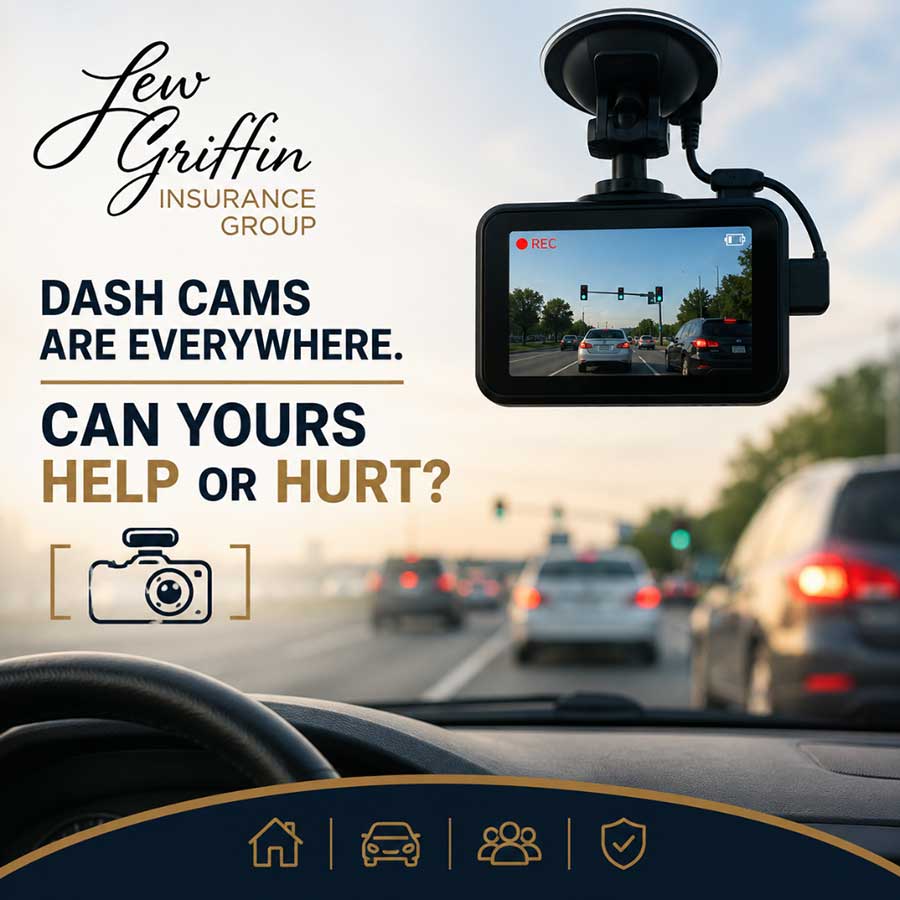
You’re driving down I-270 when another driver suddenly changes lanes and clips your car.
They say you came into their lane.
You say they came into yours.
No witnesses stopped. No police officer actually saw the accident.
But your dash cam did.
Dash cams have become increasingly common on Central Ohio roads, and for good reason. A relatively inexpensive camera can capture the few seconds that completely change the conversation after an accident.
But there’s something drivers sometimes forget:
A dash cam records what the other driver did—and what you did, too.
At Lew Griffin Insurance Group, we think drivers should understand both sides before relying on dash-cam footage after an accident.
How Can a Dash Cam Help an Insurance Claim?
One of the hardest parts of some auto insurance claims is determining exactly what happened.
Imagine an accident at Broad and Hamilton in Gahanna.
You had the green light.
The other driver insists they had the green light.
Without witnesses or video, the insurance companies may have to rely on statements, vehicle damage, police reports and other available evidence.
Dash-cam footage could provide another important piece of the puzzle.
Depending on what it captures, video may help document:
- Which vehicle changed lanes
- The position of the vehicles before impact
- Traffic signals
- Sudden braking
- A vehicle pulling into traffic
- Road or weather conditions
- A hit-and-run vehicle
- Events immediately before an accident
In situations where two drivers remember things very differently, objective video can be extremely useful.
But Can Dash-Cam Footage Hurt You?
Potentially.
Your camera doesn't take sides.
Let's say the other driver ran a stop sign—but your footage also shows that you were driving too fast for conditions.
Or perhaps the video shows you looking away from the road moments before impact.
That doesn't automatically determine the outcome of an insurance claim. But footage showing your own actions could become relevant when insurers, attorneys or others are evaluating what happened.
That's the tradeoff with having an objective record of an accident:
The camera records the good, the bad and everything in between.
Ohio Fault Can Be More Complicated Than “Who Caused It?”
Another misconception is that every accident has one driver who is 100% responsible and another who is 0% responsible.
That's not always how it works.
Ohio follows a modified comparative negligence system. That means responsibility for an accident can potentially be divided between drivers.
For example, one driver might be considered primarily responsible for causing a collision while the other driver's actions are determined to have contributed to it.
That makes good evidence even more important.
After an Accident, Preserve the Video
This may be the most important dash-cam advice we can give:
Don't assume the footage will still be there tomorrow.
Many dash cams continuously record and eventually overwrite older video.
After an accident, once you're safely able to do so, make sure the relevant footage is preserved according to your camera's instructions.
Depending on the device, that might mean locking the recording, removing the memory card, transferring the file to your phone or computer, or backing it up to cloud storage.
And don't edit the original footage.
Keep the complete original recording whenever possible.
A Dash Cam Doesn't Replace What You Should Do After an Accident
Even if you captured everything on video, you should still take the normal steps after a collision.
Make sure everyone is safe and call for emergency assistance when necessary. Exchange information with the other driver. Take pictures of the vehicles, license plates, damage and accident scene. Get contact information from witnesses when possible.
And contact your insurance agent promptly.
The dash cam is another piece of evidence—not a replacement for everything else.
Should You Tell Your Insurance Company You Have Dash-Cam Footage?
If you've been involved in an accident and have relevant footage, talk with your insurance agent or claims representative about it.
Don't immediately post the video to Facebook, TikTok or a neighborhood group because you're angry about what happened.
Once something is online, you can't control where it goes or how it's interpreted.
Your first call should be to the people helping you navigate the claim—not social media.
Technology Changes. Good Advice Doesn't.
Cars are getting smarter. Cameras are getting cheaper. And drivers have access to more information about what happened during an accident than ever before.
But technology doesn't necessarily make insurance claims simple.
Sometimes a 30-second video answers every question.
Sometimes it creates several new ones.
That's why having someone you can actually call when something happens still matters.
At Lew Griffin Insurance Group, we're here before, during and after the claim to help our clients understand their coverage and navigate what comes next.
Because a camera can show what happened.
But your insurance is only as good as your agent.
Lew Griffin Insurance Group
Gahanna & Baltimore, Ohio
Home • Auto • Life • Business